Navigating Postmodernism as Predicament and Promise:
A Critical Analysis of Akbar S. Ahmed’s Thought
Keywords:
Postmodernism,, Predicament,, Promise,, Akbar S. Ahmed,, Islam, WestAbstract
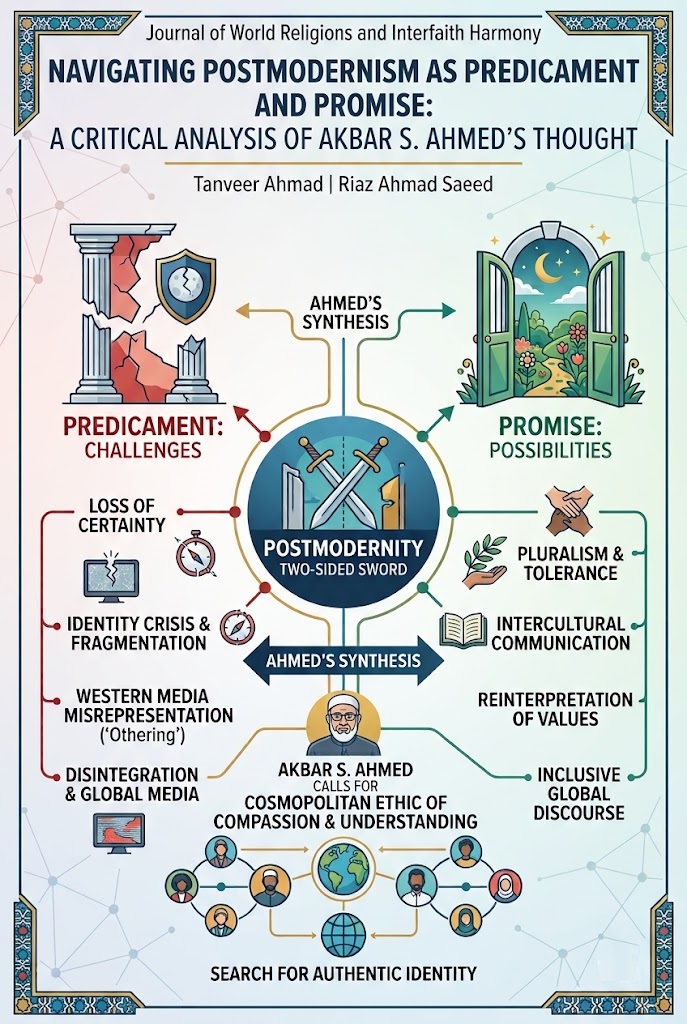
In this paper, we critically analyze Akbar S. Ahmed's views on postmodernism as a predicament and a promise for Muslim societies. For Ahmed, postmodernity is a “two-sided sword” that challenges the authority of the past and presents the possibility for new avenues of dialogue and reinterpretation of Islamic values. In the postmodern context of today, which is characterized by doubt, disintegration and a pervasive global media, Muslim identity, community and tradition are facing significant challenges. Some of these problems involve a loss of certainty, an identity crisis caused by cultural fragmentation and the misrepresentation of Islam as a singular “other” in the western imagination. Meanwhile, Ahmed argues that there is a positive side: postmodern plurality can open up new room for pluralism, tolerance and intercultural communication. In this paper, Ahmed's key ideas are explored: a search for authentic identity, the role of representation in media and politics, and the promise of a more inclusive global discourse. He calls for a cosmopolitan ethic of compassion and understanding as a way to deal with the fundamental uncertainties that confront today's Muslims.
References
Ahmed, Akbar S. Discovering Islam: Making Sense of Muslim History and Society. London: Routledge, 1988.
Ahmed, Akbar S. Islam Under Siege: Living Dangerously in a Post-Honor World. Cambridge: Polity Press, 2003.
Ahmed, Akbar S. Journey into America: The Challenge of Islam. Washington, DC: Brookings Institution Press, 2010.
Ahmed, Akbar S. Postmodernism and Islam: Predicament and Promise. London: Routledge, 1992.
Ahmed, Akbar S. “Postmodernist Perceptions of Islam: Observing the Observer.” Asian Survey 31, no. 3 (1991): 213–31.
Ahmed, Akbar S. “Postmodernist Visions of Islam: The Viewer of the Viewer.” Asian Survey 31, no. 3 (1991): 213–31.
Ahmed, Akbar S., and Hastings Donnan, eds. Islam, Globalization and Postmodernity. London: Routledge, 1994.
Akhtar, Shabbir. The Qur’an and the Secular Mind: A Philosophy of Islam. London: Routledge, 2007.
Baudrillard, Jean. Simulacra and Simulation. Translated by Sheila Faria Glaser. Ann Arbor: University of Michigan Press, 1994.
Gellner, Ernest. Postmodernism, Reason and Religion. London: Routledge, 1992.
Harvey, David. The Condition of Postmodernity: An Enquiry into the Origins of Cultural Change. Oxford: Blackwell, 1989.
Jameson, Fredric. Postmodernism, or, The Cultural Logic of Late Capitalism. Durham, NC: Duke University Press, 1991.
Lyotard, Jean-François. The Postmodern Condition: A Report on Knowledge. Translated by Geoffrey Bennington and Brian Massumi. Minneapolis: University of Minnesota Press, 1984.
Sardar, Ziauddin. The A to Z of Postmodern Life: Essays on Global Culture in the Noughties. London: Vision, 2002.
Sardar, Ziauddin. Postmodernism and the Other: The New Imperialism of Western Culture. London: Pluto Press, 1998.
Sardar, Ziauddin. A Ziauddin Sardar Reader: Islam, Postmodernism and Other Futures. Edited by Sohail Inayatullah and Gail Boxwell. London: Pluto Press, 2003.
Schwartz, Benjamin I. The World of Thought in Ancient China. Cambridge, MA: Harvard University Press, 1985.
Sharafuddin, Mohammed. “Islam and Postmodernism: Akbar Ahmed’s Vision of Islamic Adventism.” Critique: Journal for Critical Studies of the Middle East 4, no. 6 (1995): 101–8.
Turner, Bryan S. Review of Postmodernism and Islam: Predicament and Promise, by Akbar S. Ahmed. Modern Asian Studies 27, no. 4 (1993): 897–902.
Zhuangzi [Chuang Tzu]. The Complete Works of Chuang Tzu. Translated by Burton Watson. New York: Columbia University Press, 1968.
Downloads
Published
Issue
Section
License
Copyright (c) 2026 Tanveer Ahmad , Riaz Ahmad Saeed

This work is licensed under a Creative Commons Attribution 4.0 International License.