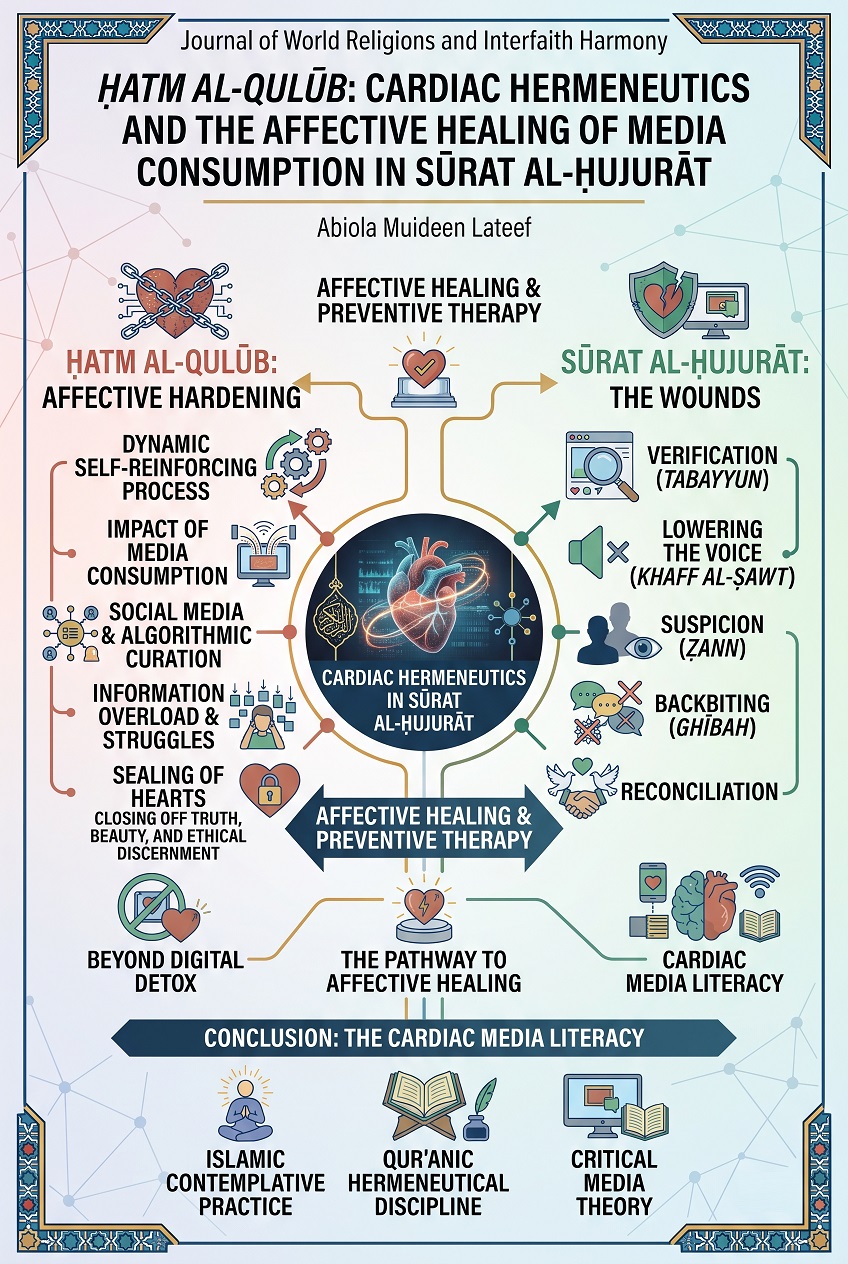
Ḥatm al-qulūb: Cardiac Hermeneutics and the Affective Healing of Media Consumption in Sūrat al-Ḥujurāt
Keywords:
Sūrat al-Ḥujurāt, cardiac hermeneutics, media consumption, affect theory, heart-centered interpretation, digital ethics, tazkiyah, tabayyun, Qurʾanic psychologyAbstract
ABSTRACT
Sūrat al-Ḥujurāt (Qurʾan 49) explicates various states of heart (qalb) such as its state of health and sickness and the process of tazkiyah that restores it. This provides the framework for navigating how media environments could wound or potentially heal human consciousness. Drawing on classical tafsīr, Sufi psychology, affect theory, and even neurocardiology, this paper traces how key themes of the sūrah like verification (tabayyun), lowering the voice (khafḍ al-ṣawt), suspicion (ẓann), and backbiting (ghībah) can map onto our struggles with social media, algorithmic curation, and information overload. It is argued that ḥatm al-qulūb, the sealing of hearts, need not be read as a static divine punishment. Instead, it functions as a dynamic, self-reinforcing process of affective hardening which is gradually produced by repeated media consumption patterns. Consequently, digital environments are also capable of closing us off from truth, beauty, and ethical discernment. However, the sūrah provides a healing that transcends digital detoxes and standard media literacy programmes by offering some positive prescriptions such as testing of the heart for taqwā, making faith beloved within it and orienting it toward reconciliation. Thus, there is need for cardiac media literacy, such that weaves together Islamic contemplative practice, Qurʾanic hermeneutical discipline, and critical media theory.
References
Ahmed, Akbar S. Discovering Islam: Making Sense of Muslim History and Society. London: Routledge, 1988.
Ahmed, Akbar S. Islam Under Siege: Living Dangerously in a Post-Honor World. Cambridge: Polity Press, 2003.
Ahmed, Akbar S. Journey into America: The Challenge of Islam. Washington, DC: Brookings Institution Press, 2010.
Ahmed, Akbar S. Postmodernism and Islam: Predicament and Promise. London: Routledge, 1992.
Ahmed, Akbar S. “Postmodernist Perceptions of Islam: Observing the Observer.” Asian Survey 31, no. 3 (1991): 213–31.
Ahmed, Akbar S. “Postmodernist Visions of Islam: The Viewer of the Viewer.” Asian Survey 31, no. 3 (1991): 213–31.
Ahmed, Akbar S., and Hastings Donnan, eds. Islam, Globalization and Postmodernity. London: Routledge, 1994.
Akhtar, Shabbir. The Qur’an and the Secular Mind: A Philosophy of Islam. London: Routledge, 2007.
Baudrillard, Jean. Simulacra and Simulation. Translated by Sheila Faria Glaser. Ann Arbor: University of Michigan Press, 1994.
Gellner, Ernest. Postmodernism, Reason and Religion. London: Routledge, 1992.
Harvey, David. The Condition of Postmodernity: An Enquiry into the Origins of Cultural Change. Oxford: Blackwell, 1989.
Jameson, Fredric. Postmodernism, or, The Cultural Logic of Late Capitalism. Durham, NC: Duke University Press, 1991.
Lyotard, Jean-François. The Postmodern Condition: A Report on Knowledge. Translated by Geoffrey Bennington and Brian Massumi. Minneapolis: University of Minnesota Press, 1984.
Sardar, Ziauddin. The A to Z of Postmodern Life: Essays on Global Culture in the Noughties. London: Vision, 2002.
Sardar, Ziauddin. Postmodernism and the Other: The New Imperialism of Western Culture. London: Pluto Press, 1998.
Sardar, Ziauddin. A Ziauddin Sardar Reader: Islam, Postmodernism and Other Futures. Edited by Sohail Inayatullah and Gail Boxwell. London: Pluto Press, 2003.
Schwartz, Benjamin I. The World of Thought in Ancient China. Cambridge, MA: Harvard University Press, 1985.
Sharafuddin, Mohammed. “Islam and Postmodernism: Akbar Ahmed’s Vision of Islamic Adventism.” Critique: Journal for Critical Studies of the Middle East 4, no. 6 (1995): 101–8.
Turner, Bryan S. Review of Postmodernism and Islam: Predicament and Promise, by Akbar S. Ahmed. Modern Asian Studies 27, no. 4 (1993): 897–902.
Zhuangzi [Chuang Tzu]. The Complete Works of Chuang Tzu. Translated by Burton Watson. New York: Columbia University Press, 1968.
Downloads
Published
Issue
Section
License
Copyright (c) 2026 Abiola Muideen Lateef

This work is licensed under a Creative Commons Attribution 4.0 International License.