The Role of Islamic Sufism and Mysticism in Interfaith Dialogue: From Waḥdat al-Wujūd to Peaceful Coexistence
Keywords:
Sufism, Waḥdat al-Wujūd, Ibn al-ʿArabi, Rumi, Interfaith Dialogue, Religious PluralismAbstract
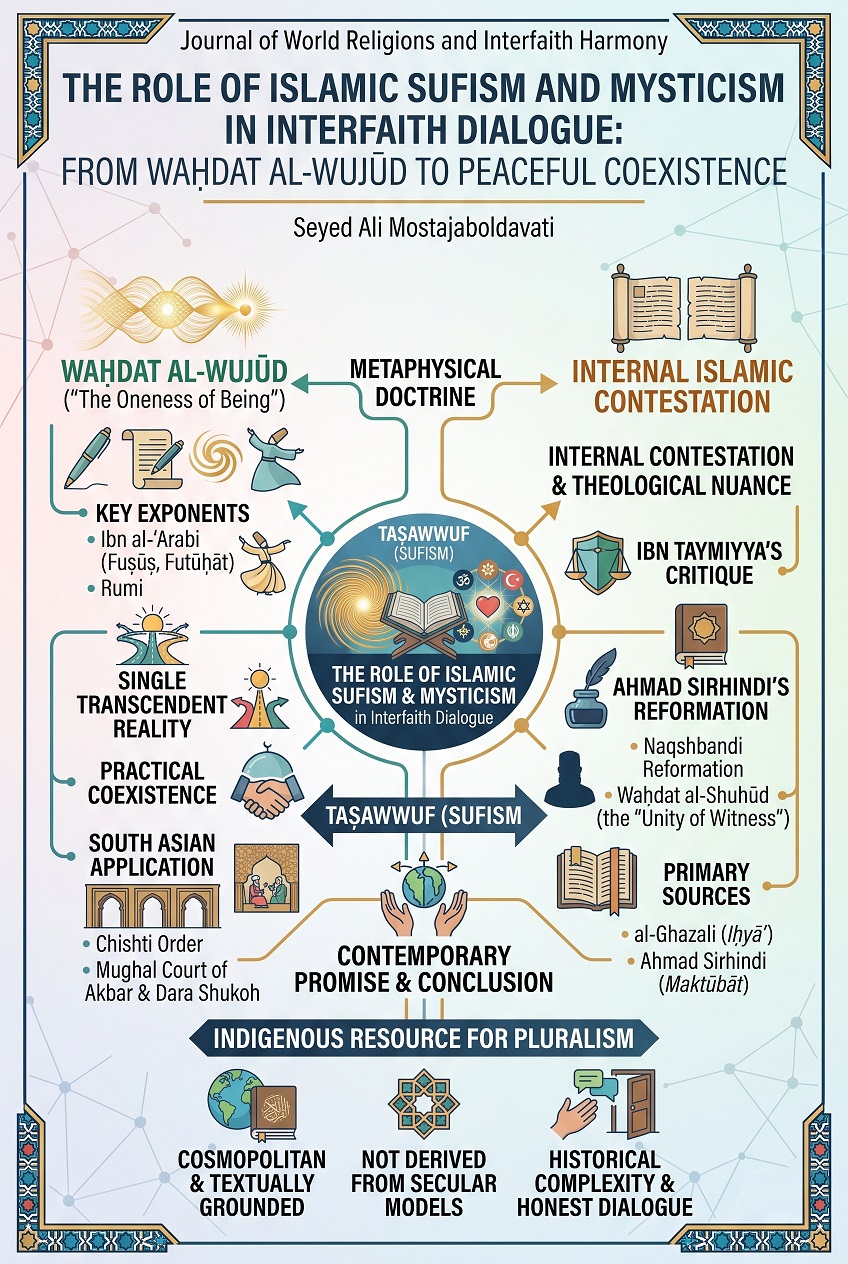
This article examines the historical and doctrinal contribution of Islamic Sufism (taṣawwuf) to the theory and practice of interfaith dialogue, focusing on the metaphysical doctrine of waḥdat al-wujūd ("the Oneness of Being") articulated by Muhyi al-Din Ibn al-ʿArabi and disseminated across the Muslim world through poets such as Jalal al-Din Rumi. Drawing directly on primary Sufi texts — Ibn al-ʿArabi's Fuṣūṣ al-Ḥikam, al-Futūḥāt al-Makkiyya, and al-Tadbīrāt al-Ilāhiyya; al-Ghazali's Iḥyāʾ ʿUlūm al-Dīn; and the Maktūbāt of Shaykh Ahmad Sirhindi — alongside the major secondary scholarship on these traditions, the article argues that Sufi metaphysics, by situating the diversity of religious forms within a single transcendent Reality, has functioned historically not merely as a private mystical philosophy but as a practical framework for religious coexistence, most visibly in the composite religious culture of South Asia under the Chishti order and the Mughal court of Akbar and Dara Shukoh. Locating this heritage within the comparative study of mysticism and within contemporary interfaith initiatives, the article also takes seriously the doctrine's long history of internal Islamic contestation, from Ibn Taymiyya's critique to Ahmad Sirhindi's own Naqshbandi reformation, waḥdat al-shuhūd. It concludes that waḥdat al-wujūd offers Muslim societies, and South Asian Islam in particular, an indigenous, textually grounded, and theologically serious resource for religious pluralism that need not be derived from secular models of tolerance, provided its historical complexity and internal contestation are honestly acknowledged rather than elided.
References
Addas, Claude. Quest for the Red Sulphur: The Life of Ibn ʿArabi. Translated by Peter Kingsley. Cambridge: Islamic Texts Society, 1993.
Alam, Muzaffar. "The Mughals, the Sufi Shaikhs and the Formation of the Akbari Dispensation." Modern Asian Studies 43, no. 1 (2009): 135–174.
al-Ghazali, Abu Hamid. Fayṣal al-Tafriqa bayna al-Islam wa al-Zandaqa. Translated by Sherman A. Jackson as On the Boundaries of Theological Tolerance in Islam. Karachi: Oxford University Press, 2002.
al-Ghazali, Abu Hamid. Iḥyāʾ ʿUlūm al-Dīn. Vol. 1, Kitāb al-ʿIlm. Cairo: Lajnat Nashr al-Thaqāfa al-Islāmiyya, 1356–57/1937–38. Digitized edition, Internet Archive, item 1_20211218_20211218.
al-Hujwiri, ʿAli ibn ʿUthman. The Kashf al-Maḥjúb: The Oldest Persian Treatise on Sufism. Translated by Reynold A. Nicholson. London: Luzac & Co., 1911.
Ayoub, Mahmoud. A Muslim View of Christianity: Essays on Dialogue. Edited by Irfan A. Omar. Maryknoll, NY: Orbis Books, 2007.
Chittick, William C. Ibn ʿArabi: Heir to the Prophets. Oxford: Oneworld Publications, 2005.
Chittick, William C. "Rumi and Waḥdat al-Wujūd." In Poetry and Mysticism in Islam: The Heritage of Rumi, edited by Amin Banani, Richard Hovannisian, and Georges Sabagh, 70–111. Cambridge: Cambridge University Press, 1994.
Chittick, William C. The Sufi Path of Knowledge: Ibn al-ʿArabi's Metaphysics of Imagination. Albany: State University of New York Press, 1989.
Chittick, William C. The Sufi Path of Love: The Spiritual Teachings of Rumi. Albany: State University of New York Press, 1983.
Dara Shukoh. Majmaʿ-ul-Bahrain, or, The Mingling of the Two Oceans. Translated by M. Mahfuz-ul-Haq. Calcutta: The Asiatic Society of Bengal, 1929.
Digby, Simon. "The Sufi Shaykh as a Source of Authority in Medieval India." In India's Islamic Traditions, 711–1750, edited by Richard M. Eaton, 234–262. New Delhi: Oxford University Press, 2003.
Eaton, Richard M. "Court of Man, Court of God: Local Perceptions of the Shrine of Baba Farid." In Sufis of Bijapur, 1300–1700: Social Roles of Sufis in Medieval India, 214–232. Princeton: Princeton University Press, 1978.
Ernst, Carl W. The Shambhala Guide to Sufism. Boston: Shambhala Publications, 1997.
Ernst, Carl W., and Bruce B. Lawrence. Sufi Martyrs of Love: Chishti Sufism in South Asia and Beyond. New York: Palgrave Macmillan, 2002.
Friedmann, Yohanan. Shaykh Ahmad Sirhindi: An Outline of His Thought and a Study of His Image in the Eyes of Posterity. Montreal: McGill-Queen's University Press, 1971.
Gandhi, Supriya. The Emperor Who Never Was: Dara Shukoh in Mughal India. Cambridge, MA: Harvard University Press, 2020.
Griffel, Frank. Al-Ghazali's Philosophical Theology. Oxford: Oxford University Press, 2009.
Ibn al-ʿArabi, Muhyi al-Din. The Bezels of Wisdom. Translated by R. W. J. Austin. New York: Paulist Press, 1980.
Ibn al-ʿArabi, Muhyi al-Din. al-Futūḥāt al-Makkiyya. Vol. 1. Edited by Ahmad Shams al-Din. Beirut: Dar al-Kutub al-ʿIlmiyya, 1994. Digitized edition, Internet Archive, item FTMAKIA.
Ibn al-ʿArabi, Muhyi al-Din. Fuṣūṣ al-Ḥikam. Cairo, n.d. Digitized edition, Internet Archive, item abeer_20160509. Cf. critical edition, edited by Abu'l-ʿAla ʿAfifi. Cairo: Dar Ihya al-Kutub al-ʿArabiyya, 1946.
Ibn al-ʿArabi, Muhyi al-Din. al-Tadbīrāt al-Ilāhiyya fī Iṣlāḥ al-Mamlaka al-Insāniyya. Damascus/Beirut, n.d. Digitized edition, Internet Archive, item Tercha.amm2018_20180325_1044.
Izutsu, Toshihiko. Sufism and Taoism: A Comparative Study of Key Philosophical Concepts. Berkeley: University of California Press, 1983.
Jackson, Sherman A. Translator's introduction to On the Boundaries of Theological Tolerance in Islam, by Abu Hamid al-Ghazali, 1–45. Karachi: Oxford University Press, 2002.
Katz, Steven T. "Language, Epistemology, and Mysticism." In Mysticism and Philosophical Analysis, edited by Steven T. Katz, 22–74. New York: Oxford University Press, 1978.
Knysh, Alexander D. Ibn ʿArabi in the Later Islamic Tradition: The Making of a Polemical Image in Medieval Islam. Albany: State University of New York Press, 1999.
Lewis, Franklin D. Rumi: Past and Present, East and West. Oxford: Oneworld Publications, 2000.
Nicholson, Reynold A., trans. The Tarjumán al-Ashwáq: A Collection of Mystical Odes by Muhyi'ddín Ibn al-ʿArabí. London: Royal Asiatic Society, 1911.
Rozehnal, Robert. Islamic Sufism Unbound: Politics and Piety in Twenty-First-Century Pakistan. New York: Palgrave Macmillan, 2007.
Rumi, Jalal al-Din. The Mathnawi of Jalalu'ddin Rumi. Vol. 2. Translated by Reynold A. Nicholson. London: Luzac & Co., 1926.
Schimmel, Annemarie. Mystical Dimensions of Islam. Chapel Hill: University of North Carolina Press, 1975.
Schuon, Frithjof. The Transcendent Unity of Religions. New York: Harper & Row, 1975.
Shah-Kazemi, Reza. Common Ground Between Islam and Buddhism. Louisville: Fons Vitae, 2010.
Shah-Kazemi, Reza. "Divine Mercy and the Unity of Religions." In A Common Word: Muslims and Christians on Loving God and Neighbor, edited by Miroslav Volf, Ghazi bin Muhammad, and Melissa Yarrington, 172–195. Grand Rapids: Eerdmans, 2010.
Shah-Kazemi, Reza. Paths to Transcendence: According to Shankara, Ibn Arabi, and Meister Eckhart. Bloomington: World Wisdom, 2006.
Sirhindi, Ahmad. Maktūbāt-i Imām Rabbānī. Daftar-i Awwal. Lahore, n.d. Digitized edition, Internet Archive, item 77-ketabeerfani.
Watt, W. Montgomery. Muslim Intellectual: A Study of al-Ghazali. Edinburgh: Edinburgh University Press, 1963.
Werbner, Pnina. Pilgrims of Love: The Anthropology of a Global Sufi Cult. Bloomington: Indiana University Press, 2003.
Downloads
Published
Issue
Section
License
Copyright (c) 2026 Seyed Ali Mostajaboldavati

This work is licensed under a Creative Commons Attribution 4.0 International License.