A Comparative Conceptual Analysis of “bənê hā’ĕlōhîm” (“Sons of God”) in the Qur’ān and Jewish Texts: Examining the Attribution of Polytheism to Jews in the Story of ‘Uzayr in Qur’ān
Keywords:
bənê hā’ĕlōhîm, Ibn Allāh, ʿUzayr, Islam, JudaismAbstract
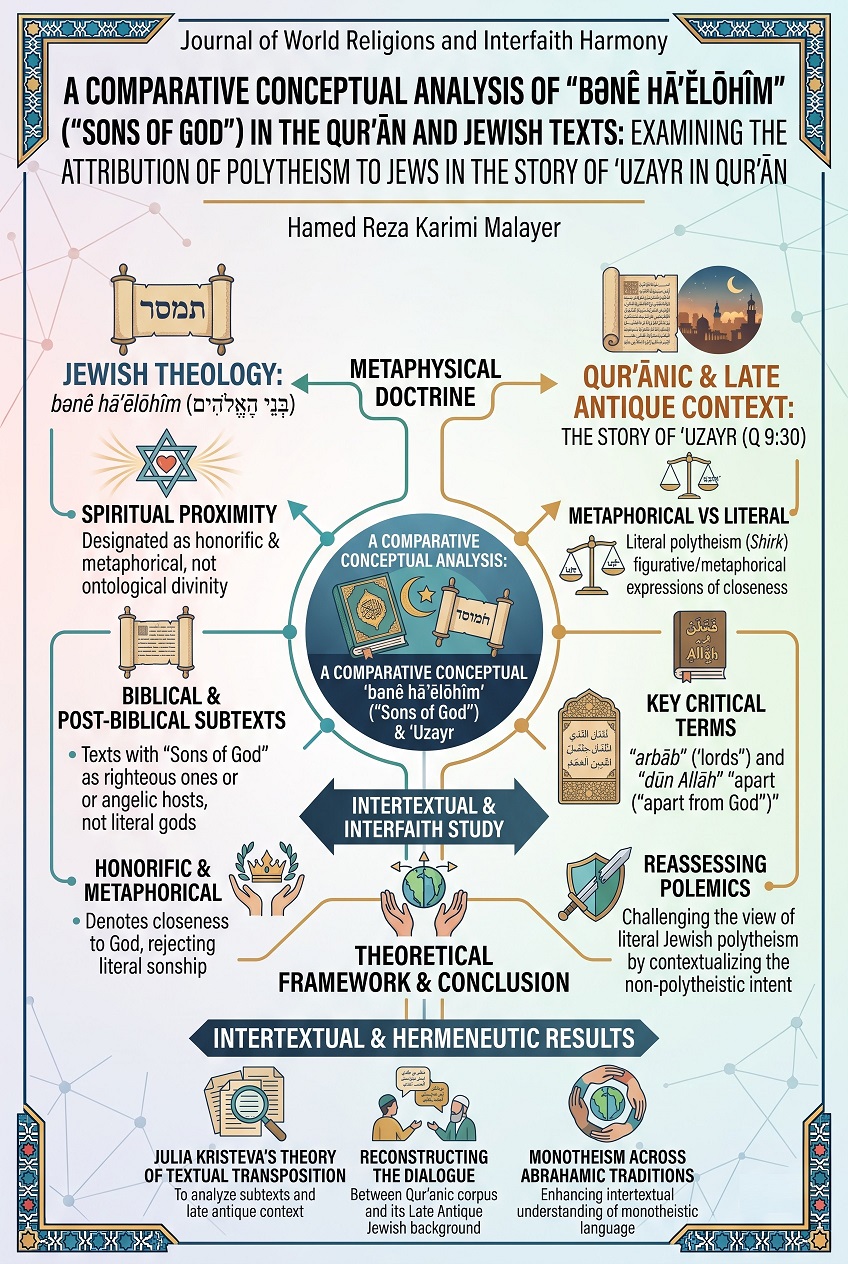
This paper offers a comparative conceptual analysis of the expression bənê hā’ĕlōhîm (בְּנֵי הָאֱלֹהִים, “Sons of God”) within Jewish theology and the Qur’ānic reference to ʿUzayr in verse Q 9:30. Employing an intertextual framework informed by Julia Kristeva’s theory of textual transposition and late antique Qur’anic hermeneutics, this study reassesses the dialogue between the Qur’anic corpus and its Biblical/post-Biblical subtexts. Contrary to conventional exegetical readings that attribute literal polytheism (Shirk) to Jews for this expression, I argue that both traditions fundamentally employ such idioms metaphorically and honorifically, designating spiritual proximity rather than ontological divinity. By analyzing the semantic trajectory along both historical and intertextual axes—particularly through key Qur’ānic terms such as arbāb (“lords”) and dūn Allāh (“apart from God”)—this study challenges traditional polemical readings and repositions the Qur’ān’s theological critique within its broader Late Antique context. Ultimately, this approach facilitates a more nuanced intertextual understanding of monotheism across Abrahamic traditions and contributes to current debates on scriptural semantics and interfaith hermeneutics.
References
‘Āshūrī, Seyyid Lokmān. Zubdat al-Tawārīkh [Cream of Histories]. 993 AH / 1583 CE. Manuscript Ms. 1973. Türk ve İslâm Eserleri Müzesi [Museum of Turkish and Islamic Arts], Istanbul.
“Ezra.” In Encyclopaedia Judaica. 2nd ed. Vol. 6. Farmington Hills, MI: Macmillan Reference, 2007.
Abu-Rabiʿ, Ibrahim M. “Ezra.” In Encyclopaedia of the Qurʾān, edited by Jane Dammen McAuliffe. Leiden: Brill, 2006.
Adang, Camilla. Muslim Writers on Judaism and the Hebrew Bible: From Ibn Rabban to Ibn Hazm. Islamic Philosophy, Theology and Science, Texts and Studies 30. Leiden: E. J. Brill, 1996.
al-Azharī, Abū Manṣūr Muḥammad ibn Aḥmad. Tahdhīb al-lughah. Edited by Muḥammad ʿAwaḍ Murʿib. 8 vols. Beirut: Dār Iḥyāʾ al-Turāth al-ʿArabī, 2001.
Al-Rāghib al-Iṣfahānī, Abū al-Qāsim al-Ḥusayn ibn Muḥammad. Mufradāt alfāẓ al-Qurʾān. Edited by Ṣafwān ‘Adnān Dāwūdī. Damascus: Dār al-Qalam, 1992, 336.
Bāqir, Muḥammad. Namūna-yi bayānāt dar shaʾn-i nuzūl-i āyāt. 4th ed. Tihrān: Intishārāt-i Islāmī, 1361 SH/1982.
Comerro, Viviane. “Esdras est-il le fils de Dieu?” Arabica 52, no. 2 (2005): 170–173. Brill.
Davies, Jon, ed. Words Remembered, Text Renewed: Essays in Honour of John F.A. Sawyer. Sheffield: JSOT Press, 1995..
Douglas, J. D., Merrill C. Tenney, and Moisés Silva, eds. Zondervan Illustrated Bible Dictionary. Rev. ed. Grand Rapids, MI: Zondervan, 2011.
Encyclopedia of the Holy Prophet and Companions. 27 vols. Edited by International Group of Islamic Scholars. New Delhi: Anmol Publications, 2004. s.v. “ʿUzayr.”
Firestone, Reuven. Children of Abraham: An Introduction to Judaism for Muslims. New York: American Jewish Committee, 2001, pp. 35–36.
Geiger, Abraham. Judaism and Islam. Translated by F. M. Young. New York: Ktav, 1970.
Gritten, Stephen. “John Wansbrough Remembered: Interview with Gerald Hawting.” ABC Radio National – The Religion Report, 26 June 2002. https://www.abc.net.au/radionational/programs/archived/religionreport/john-wansbrough-remembered/3512288 (accessed 13 September 2007).
Haqqani Fazl, Muhammad, and Abd al-Rahim Soleimani Ardestani. “Barrasi-ye estedlālhā-ye modāfeʿān-e khaṭāpaziri-ye Ketāb-e Moqaddas” [Analysis of the Arguments of Inerrancy Advocates for the Bible]. Falsafeh-ye Din 7, no. 6 (Summer 2019): 135–59.
Ibn Ḥazm, ‘Alī ibn Aḥmad. Al-Fiṣal fī al-milal wa-al-ahwā’ wa-al-niḥal [The separator concerning religions, heresies, and sects]. Edited by Muḥammad Ibrāhīm Naṣr and ‘Abd al-Raḥmān ‘Umayrah. 5 vols. Beirut: Dār al-Jīl, 1996.
Ibn Kathīr, Ismāʿīl ibn ʿUmar. “ʿUzair (Ezra).” In Stories of the Quran. Translated by Ali As-Sayed Al-Halawani. Islambasics.com, 2007.
Ibn Kathīr, Ismāʿīl ibn ʿUmar. Qiṣaṣ al-anbiyā’. Edited by Muṣṭafā ʿAbd al-Wāḥid. Cairo: Maṭbaʿat Dār al-Taʾlīf, 1388 AH/1968 CE.
Ibn Qayyim al-Jawziyya, Muḥammad ibn Abī Bakr. Hidāyat al-ḥayārā fī ajwibat al-yahūd wa-al-naṣārā [Guidance for the confused in answering the Jews and Christians]. Edited by Muḥammad Aḥmad al-Ḥājj. 2 vols. Jeddah: Dār al-Qalam, 1996.
Jackson, David R. Enochic Judaism: Three Defining Paradigm Exemplars. Library of Second Temple Studies 49. London: T&T Clark International, 2004.
Kohler, Kaufmann, and Ignatz Goldziher. “Islam.” In The Jewish Encyclopedia. New York: Funk and Wagnalls, 1906. https://www.jewishencyclopedia.com/articles/8212-islam.
Kristeva, Julia. Desire in Language: A Semiotic Approach to Literature and Art. Edited by Leon S. Roudiez. Translated by Thomas Gora, Alice Jardine, and Leon S. Roudiez. New York: Columbia University Press, 1980.
Lazarus-Yafeh, Hava. “ʿUzayr.” In Encyclopaedia of Islam. 2nd ed. Edited by P. Bearman, Th. Bianquis, C. E. Bosworth, E. van Donzel, and W. P. Heinrichs. Leiden: Brill, 2012.
Maimonides, Moses. “Mishneh Torah.” In Jewish Studies. Oxford Bibliographies. Oxford University Press. Accessed May 13, 2018. http://www.oxfordbibliographies.com/view/document/obo-9780199840731/obo-9780199840731-0152.xml.
Milstein, Rachel, Karin Rührdanz, and Barbara Schmitz. Stories of the Prophets: Illustrated Manuscripts of Qiṣaṣ al-Anbiyā’. Costa Mesa, CA: Mazda Publishers, 1999.
Neusner, Jacob. Introduction to Rabbinic Literature. The Anchor Yale Bible Reference Library. New York: Doubleday, 1994.
Neuwirth, Angelika. The Qur’an and Late Antiquity: A Shared Heritage. Translated by Samuel Wilder. Oxford: Oxford University Press, 2019.
Newby, Gordon D. A History of the Jews of Arabia: From Ancient Times to Their Eclipse under Islam. Columbia: University of South Carolina Press, 1988.
Newby, Gordon Darnell. A History of the Jews of Arabia: From Ancient Times to Their Eclipse under Islam. 2nd ed. Columbia, SC: University of South Carolina Press, 2009.
Renda, Günsel. “The Miniatures of the Zubdat al-Tawarikh.” Turkish Treasures: Culture / Art / Tourism Magazine, no. 1 (1978): 26–35.
Reynolds, Gabriel Said. The Qur’an and the Bible: Text and Commentary. New Haven: Yale University Press, 2018.
Ross, James F. Introduction to the Philosophy of Religion. London: Macmillan, 1969.
Şahin, Seracettin. The Museum of Turkish and Islamic Arts: Masterpieces of Islamic Art. Istanbul: Ministry of Culture and Tourism, 2009.
Samau’al al-Maghribī (Ibn Yaḥyā al-Maghribī). Ifḥām al-Yahūd: Silencing the Jews. Edited and translated by Moshe Perlmann. Proceedings of the American Academy for Jewish Research 32 (1964): 1–136.
Shapiro, Marc B. “Islam and the Halakhah.” Judaism: A Quarterly Journal of Jewish Life & Thought 42, no. 167 (Summer 1993): 95–291.
Sirry, Mun’im. Scriptural Polemics: The Qur’an and Other Religions. Oxford: Oxford University Press, 2014.
Stone, Michael E. Fourth Ezra: A Commentary on the Book of Fourth Ezra. Hermeneia. Minneapolis: Fortress Press, 1990.
Ṭabāṭabā’ī, Muḥammad Ḥusayn al-. Al-Mīzān fī tafsīr al-Qurʾān. 20 vols. Beirut: Mu’assasat al-A‘lamī, 1997.
Tofighi, Fatemeh. “Mafhūm-e ‘Farzandān-e Khodā’ dar Ketāb-e Moqaddas va Qur’ān-e Majīd” [The Concept of ‘Children of God’ in the Bible and The Holy Qur’an]. Haft Āsmān 13, no. 50 (2011): 73–98.
Downloads
Published
Issue
Section
License
Copyright (c) 2026 Hamed Reza Karimi Malayer

This work is licensed under a Creative Commons Attribution 4.0 International License.