Women’s Religious Leadership in Historical Perspective: An Analytical Study of Western and Muslim Contexts
Keywords:
Women’s rights, Protestant Reformation, Methodist Movement, Women’s Religious Leadership, Amina Wadud, ImamatAbstract
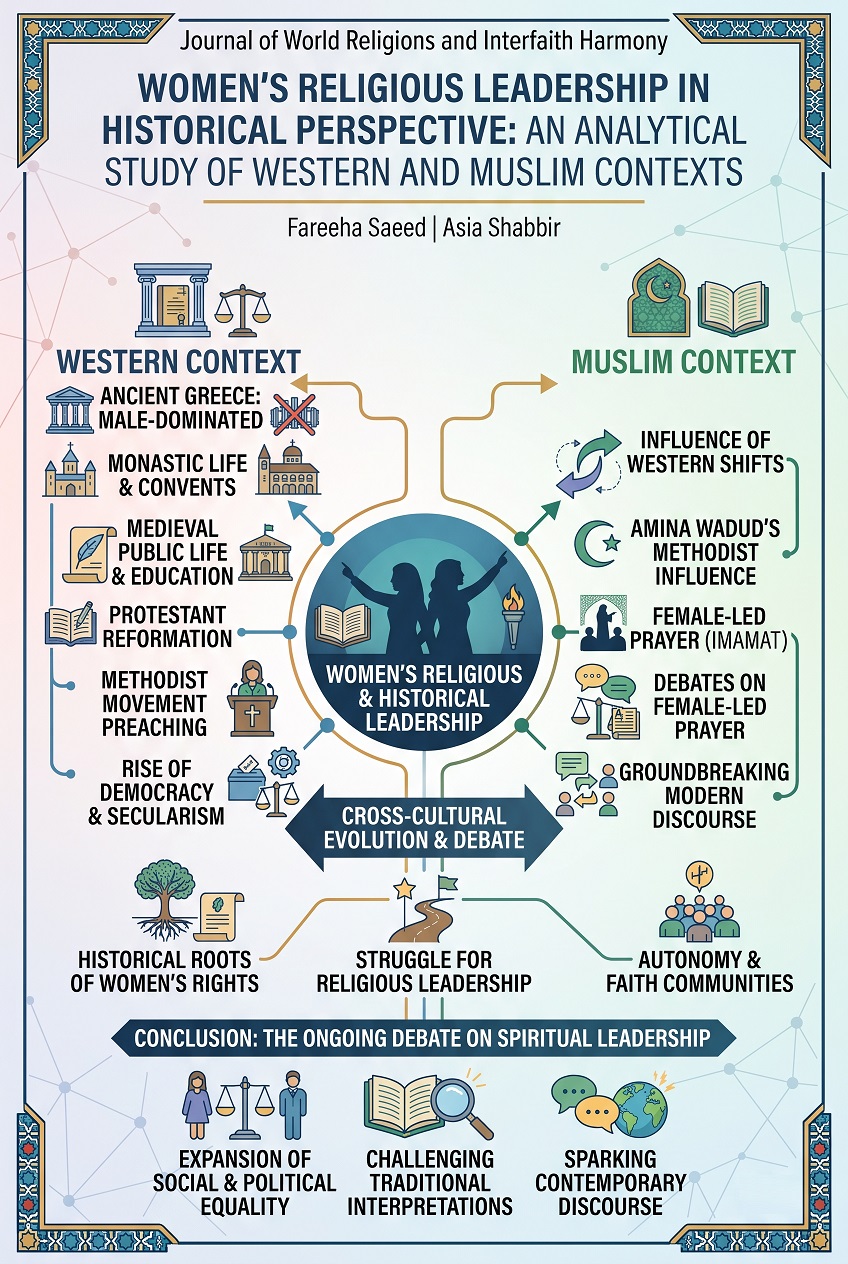
This article explores the history of women’s rights in the West and how it shapes current debates on women’s religious leadership. The struggle for women's rights is not a recent trend; it has deep historical roots. In ancient Greece, for instance, society was heavily male-dominated, leaving women with very few rights. Over time, some turned to monastic life, which offered them both social space and economic security. Gradually, women expanded beyond convent walls into public life, pursuing education during the Medieval period. The Protestant Reformation marked another turning point, encouraging women to study scripture directly and question traditional religious interpretations. Later, the Methodist movement gave women active roles in preaching. Along with the rise of democracy, secularism, and modernity, these shifts steadily broadened female autonomy. Having achieved greater equality in social and political life, women naturally began to demand equal leadership within their faith communities. Reflecting this cross-cultural evolution, Muslim feminist Amina Wadud—who grew up in a Methodist household—brought the debate over female-led prayer (imamat) to the forefront of modern Islamic discourse. In doing so, she opened up a groundbreaking conversation on women’s spiritual leadership that continues to spark debate across Muslim societies today.
References
Abu Dawud Sulayman ibn al-Ash‘ath. Sunan Abi Dawud. Vol. 1. Beirut: al-Maktabah al-‘Asriyyah, n.d.
Askari, Muhammad Hasan. Jadidiyat. Lahore: Idara-e-Farogh-e-Islam, 1994.
Encyclopaedia Britannica Online. s.v. “Convent.” https://www.britannica.com/topic/convent.
———. s.v. “Feminism.” Accessed October 30, 2026. https://www.britannica.com/topic/feminism.
———. s.v. “Methodism.” https://www.britannica.com/topic/Methodism.
———. s.v. “Second-Wave Feminism.” https://www.britannica.com/topic/second-wave-feminism.
———. s.v. “Women’s Movement.” https://www.britannica.com/event/womens-movement.
Dorling Kindersley. The Feminism Book: Big Ideas Simply Explained. New York: DK Publishing, 2019.
Durant, Will. The Life of Greece. Vol. 2 of The Story of Civilization. New York: Simon and Schuster, 1939.
El Fadl, Khaled Abou. “Fatwa on Women Leading Prayer.” Search for Beauty, April 5, 2010. https://www.searchforbeauty.org/2010/04/05/fatwa-on-women-leading-prayer/.
Educational Media Reviews Online (EMRO). Penn State University Libraries. https://emro.libraries.psu.edu/record/index/.
European Confederation of Inclusive and Progressive Muslims (CALEM). “Amina Wadud: Doctor & Imam.” https://www.calem.eu/Amina-Wadud-doctor-imam.html.
Hamidullah, Muhammad. Khutbat-e-Bahawalpur. Islamabad: Idara Tahqiqat-e-Islami, 2002.
Hammer, Juliane. American Muslim Women, Religious Authority, and Activism: More Than a Prayer. Austin: University of Texas Press, 2012.
Hesiod. Theogony and Works and Days. Translated by M. L. West. Oxford: Oxford University Press, 1988.
hooks, bell. Feminism Is for Everybody: Passionate Politics. Cambridge, MA: South End Press, 2000.
Ibn Hajar al-‘Asqalani. Tahdhib al-Tahdhib. 12 vols. Hyderabad: Da’irat al-Ma‘arif al-Nizamiyyah, 1326 AH [1908–1909 CE].
Indonesian Consortium for Religious Studies (ICRS). “Visiting Professor.” https://www.icrs.or.id/visiting-professor/.
Lerner, Gerda. The Creation of Feminist Consciousness: From the Middle Ages to Eighteen-Seventy. New York: Oxford University Press, 1993.
McElroy, Mark. “Wesley, Women, and the WCA: How John Wesley Decided Who Should Preach.” Mark McElroy (blog). https://markmcelroy.com/wesley-women-and-the-wca-how-john-wesley-decided-who-should-preach/.
ResourceUMC. “The Reformation and the Wesleys: A Complex Relationship.” https://www.resourceumc.org/en/content/the-reformation-and-the-wesleys-a-complex-relationship.
Sengupta, Shuddhabrata. “Charles Fourier: The Man Who Coined the Term ‘Feminism’.” LiveWire, March 8, 2018. https://livewire.thewire.in/livewire/charles-fourier-the-man-who-coined-the-term-feminism.
Stanton, Elizabeth Cady. The Woman’s Bible. 2 vols. New York: European Publishing Company, 1895–1898.
United Methodist Church. “Marjorie Matthews’ Journey as the UMC’s First Female Bishop.” https://www.umc.org/en/content/marjorie-matthews-journey-as-the-umcs-first-female-bishop.
VanDoodewaard, Rebecca. Reformation Women: Sixteenth-Century Figures Who Shaped Christianity’s Rebirth. Grand Rapids, MI: Reformation Heritage Books, 2017.
Wadud, Amina. “About Amina Wadud.” Amina Wadud Official Website. Accessed October 30, 2026. https://aminawadud.com/about-amina-wadud.
———. Inside the Gender Jihad: Women’s Reform in Islam. Oxford: Oneworld Publications, 2006.
———. Once in a Lifetime. Manchester: Kantara Press, 2022.
Walters, Margaret. Feminism: A Very Short Introduction. Oxford: Oxford University Press, 2005.
Willsher, Kim. “Denmark Opens Female-Led Mosque with Rare Sound of Woman Singing Friday Call to Prayer.” Daily Mail, August 27, 2016. https://www.dailymail.co.uk/news/article-3760962/Denmark-opens-female-led-mosque-rare-sound-woman-singing-Friday-call-prayer.html.
Zilberstein, Lætitia. “France: The Female Imam Leading Prayers in Paris.” France 24, February 5, 2019. https://www.france24.com/en/20190205-france-female-imam-islam-mosque-bahloul-fatima-muslim-paris/.
Downloads
Published
Issue
Section
License
Copyright (c) 2026 Fareeha Saeed, Asia Shabbir

This work is licensed under a Creative Commons Attribution 4.0 International License.