Between Karbala and the Khanqah: Muharram, Sufism, and the Making of Shared Sacred Culture in Colonial India
Keywords:
Muharram, Sufism, Karbala, Colonialism, DevotionAbstract
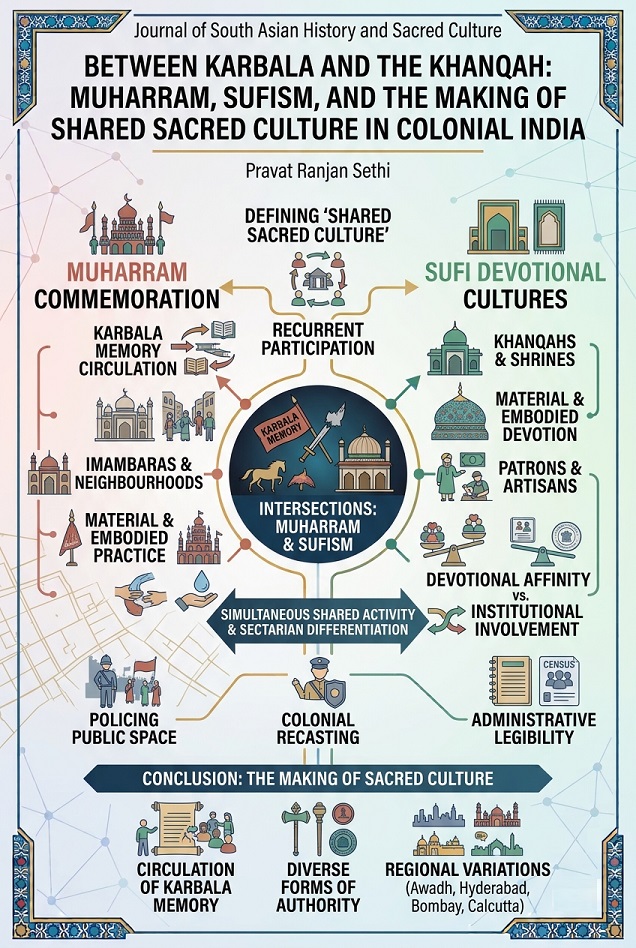
This article examines the intersections of Muharram commemoration and Sufi devotional cultures in colonial India through a selective comparison of Awadh, Hyderabad, Bombay, and Calcutta. It asks how the memory of Karbala circulated beyond formal Shiʾa institutions without producing theological consensus. Drawing on the historical sources and scholarship cited in the manuscript, it analyses the different roles of imambaras, khanqahs, shrines, patrons, artisans, and neighbourhood participants in the making of processions, taʾziyas, alams, and practices of water distribution. It defines ‘shared sacred culture’ as recurrent participation in material and embodied devotional practices that retained distinct meanings and unequal forms of authority. Rather than assuming that Sufi institutions uniformly adopted Muharram observances, the article distinguishes devotional affinity from documented institutional involvement. It also examines how colonial description, enumeration, and the policing of public space recast existing religious differences as administratively legible categories. The argument is that shared ritual activity and sectarian differentiation were historically simultaneous, not mutually exclusive.
References
Ali, Meer Hasan. Observations on the Mussulmauns of India: Descriptive of Their Manners, Customs, Habits and Religious Opinions, Made during a Twelve Years’ Residence in Their Immediate Society. Edited by William Crooke. 2nd ed. London: Humphrey Milford, Oxford University Press, 1917.
Ayoub, Mahmoud M. Redemptive Suffering in Islām: A Study of the Devotional Aspects of ʿĀshūrāʾ in Twelver Shīʿism. The Hague: Mouton, 1978.
Bayly, C. A. Empire and Information: Intelligence Gathering and Social Communication in India, 1780–1870. Cambridge: Cambridge University Press, 1996.
Bigelow, Anna. Sharing the Sacred: Practicing Pluralism in Muslim North India. New York: Oxford University Press, 2010.
Bowman, Glenn. “Process and Pluralism: A Study of Muslim, Christian, and Jewish Practices at the Shrine of St George.” Journal of the Royal Anthropological Institute 18, no. 3 (2012): 527–44.
Chittick, William C. The Sufi Path of Love: The Spiritual Teachings of Rumi. Albany: State University of New York Press, 1983.
Cohn, Bernard S. Colonialism and Its Forms of Knowledge: The British in India. Princeton, NJ: Princeton University Press, 1996.
Cohn, Bernard S. “The Census, Social Structure and Objectification in South Asia.” In An Anthropologist among the Historians and Other Essays, 224–54. Delhi: Oxford University Press, 1987.
Cole, Juan R. I. “Imami Shi‘ism from Iran to North India, 1722–1856: State, Society, and Clerical Ideology in Awadh.” PhD diss., University of California, Los Angeles, 1984.
Cole, Juan R. I. Roots of North Indian Shi‘ism in Iran and Iraq: Religion and State in Awadh, 1722–1859. Berkeley: University of California Press, 1988.
D’Souza, Diane. Partners of Zaynab: A Gendered Perspective of Shia Muslim Faith. Columbia: University of South Carolina Press, 2014.
Eaton, Richard M. “Approaches to the Study of Conversion to Islam in India.” In Approaches to Islam in Religious Studies, edited by Richard C. Martin, 106–23. Tucson: University of Arizona Press, 1985.
Freitag, Sandria B. “Sacred Symbol as Mobilizing Ideology: The North Indian Search for a ‘Hindu’ Community.” Comparative Studies in Society and History 22, no. 4 (1980): 597–625.
Gooptu, Nandini. The Politics of the Urban Poor in Early Twentieth-Century India. Cambridge: Cambridge University Press, 2001.
Gottschalk, Peter. Beyond Hindu and Muslim: Multiple Identity in Narratives from Village India. New York: Oxford University Press, 2000.
Green, Nile. Indian Sufism since the Seventeenth Century: Saints, Books and Empires in the Muslim Deccan. London: Routledge, 2006.
Hardy, P. The Muslims of British India. Cambridge: Cambridge University Press, 1972.
Hasan, Mushirul. Legacy of a Divided Nation: India’s Muslims since Independence. Boulder, CO: Westview Press, 1997.
Haynes, Douglas M. “From Tribute to Philanthropy: The Politics of Gift Giving in a Western Indian City.” Journal of Asian Studies 46, no. 2 (1987): 339–60.
Hollister, J. N. The Shi‘a of India. London: Luzac and Company, 1953.
Hyder, Syed Akbar. Reliving Karbala: Martyrdom in South Asian Memory. New York: Oxford University Press, 2006.
Jones, Justin. Shi‘a Islam in Colonial India: Religion, Community and Sectarianism. Cambridge: Cambridge University Press, 2012.
Jones, Kenneth W. Socio-Religious Reform Movements in British India. The New Cambridge History of India, vol. 3, pt. 1. Cambridge: Cambridge University Press, 1989.
Karamustafa, Ahmet T. Sufism: The Formative Period. Edinburgh: Edinburgh University Press, 2007.
Korom, Frank J. Hosay Trinidad: Muharram Performances in an Indo-Caribbean Diaspora. Philadelphia: University of Pennsylvania Press, 2003.
Llewellyn-Jones, Rosie. A Fatal Friendship: The Nawabs, the British and the City of Lucknow. Delhi: Oxford University Press, 1985.
Masselos, Jim. “Change and Custom in the Format of the Bombay Mohurrum during the Nineteenth and Twentieth Centuries.” South Asia: Journal of South Asian Studies 5, no. 2 (1982): 47–67.
McLane, John R. Indian Nationalism and the Early Congress. Princeton, NJ: Princeton University Press, 1977.
Oldenburg, Veena Talwar. The Making of Colonial Lucknow, 1856–1877. Princeton, NJ: Princeton University Press, 1984.
Pandey, Gyanendra. The Construction of Communalism in Colonial North India. Delhi: Oxford University Press, 1990.
Pinault, David. The Shiites: Ritual and Popular Piety in a Muslim Community. New York: St. Martin’s Press, 1992.
Robinson, Francis. Separatism among Indian Muslims: The Politics of the United Provinces’ Muslims, 1860–1923. Cambridge: Cambridge University Press, 1974.
Ruffle, Karen G. “Bībī kā ʿAlam.” MAVCOR Journal. Yale University.
Ruffle, Karen G. Everyday Shiʿism in South Asia. Chichester: Wiley-Blackwell, 2021.
Sardar, Marika. “The Maqbara: An Architectural Type of the Deccan.” In Sultans of the South: Arts of India’s Deccan Courts, 1323–1687, edited by Navina Najat Haidar and Marika Sardar, 182–89. New York: Metropolitan Museum of Art, 2011.
Schimmel, Annemarie. Mystical Dimensions of Islam. Chapel Hill: University of North Carolina Press, 1975.
Schubel, Vernon James. Religious Performance in Contemporary Islam: Shi‘i Devotional Rituals in South Asia. Columbia: University of South Carolina Press, 1993.
Siebenga, Rianne. “Picturing Muharram: Images of a Colonial Spectacle, 1870–1915.” South Asia: Journal of South Asian Studies 36, no. 4 (2013): 626–43.
Stewart, Charles, and Rosalind Shaw. “Introduction: Problematizing Syncretism.” In Syncretism/Anti-Syncretism: The Politics of Religious Synthesis, edited by Charles Stewart and Rosalind Shaw, 1–26. London: Routledge, 1994.
Stewart, Tony K. “In Search of Equivalence: Conceiving Muslim-Hindu Encounter through Translation Theory.” History of Religions 40, no. 3 (2001): 260–87.
Troll, Christian W., ed. Muslim Shrines in India: Their Character, History and Significance. New Delhi: Oxford University Press, 1989.
van der Veer, Peter. “Riots and Rituals: The Construction of Violence and Public Space in Hindu Nationalism.” In Riots and Pogroms, edited by Paul R. Brass, 154–76. New York: New York University Press, 1996.
Williams, Richard David. “Performing Royal Piety: Wajid ‘Ali Shah’s Muharram Commemorations in Colonial Calcutta.” Journal of the Royal Asiatic Society (2025).
Downloads
Published
Issue
Section
License
Copyright (c) 2026 Pravat Ranjan Sethi

This work is licensed under a Creative Commons Attribution 4.0 International License.